The Art of Warfare with Kamikaze drones
The Japanese invented Kamikaze warfare in World War 2. Today, it is being reinvented - but without putting our men in harms way.
Apollyon Dynamics · 31 March 2026 · 3 min read
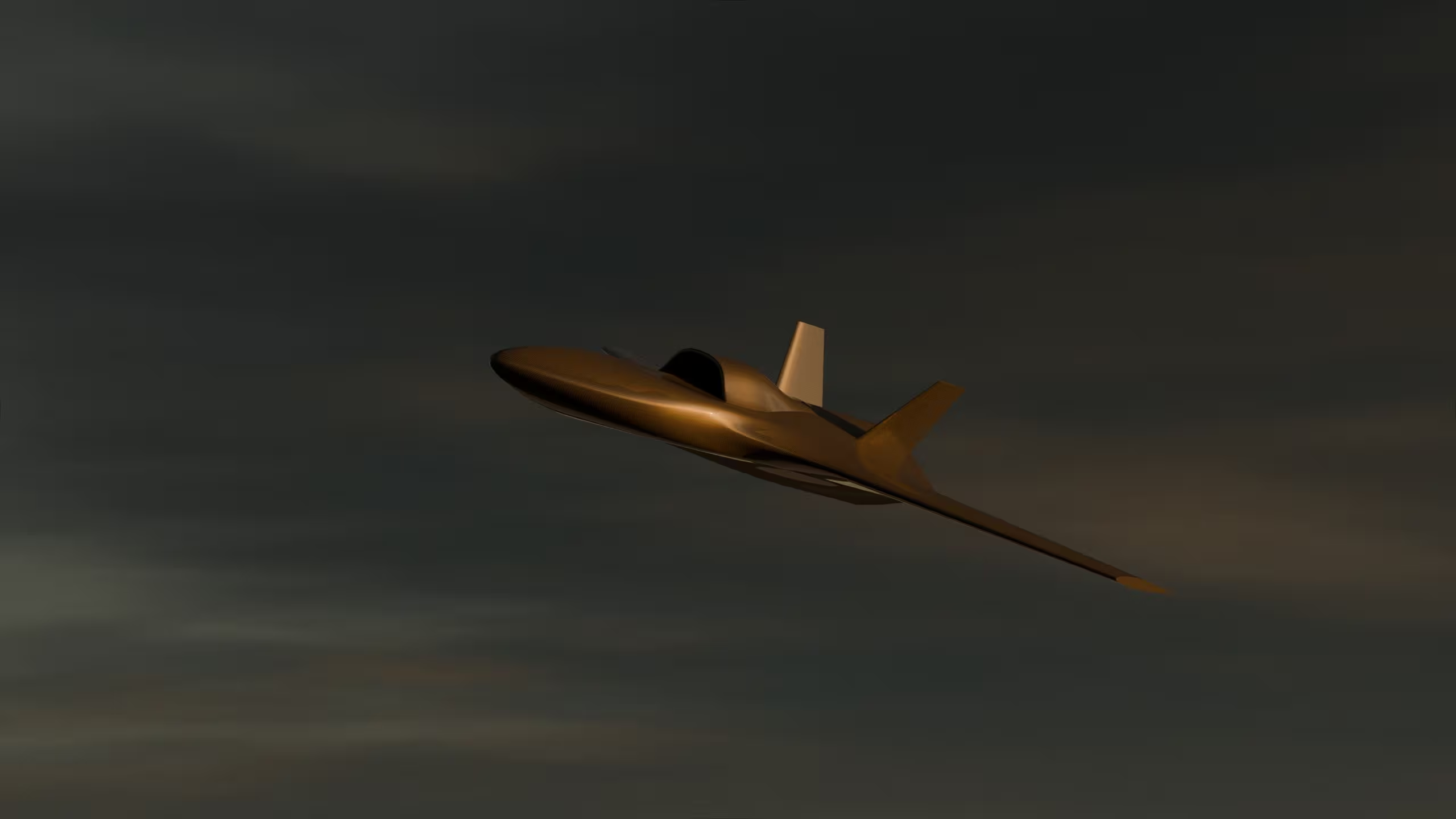
Kamikaze drones also referred to as loitering munitions or suicide drones are a class of unmanned aerial vehicles (UAVs) designed to loiter over a target area and strike by self-destructing on impact with an explosive payload. They combine the surveillance and endurance of UAVs with the destructive capacity of guided missiles.
These systems represent a paradigm shift in modern warfare, offering militaries versatile tools for both offensive precision strikes and defensive tactical operations.
What Are Kamikaze Drones?
Kamikaze drones are single-use UAVs that carry warheads and are deliberately directed into targets to detonate upon impact. Unlike traditional surveillance drones that return to base, these systems are intended to destroy themselves as part of the mission.
Key characteristics include:
Self-destructive attack profile.
Ability to loiter and search for targets before engagement.
Lightweight and low unit cost compared to manned systems.
They sit conceptually between missiles and surveillance UAVs, carrying sensors and decision-making capabilities that allow them to wait, navigate, and strike with precision.
Operational Principles
Kamikaze drones integrate multiple subsystems:
Navigation & Guidance: Via GNSS/INS, onboard autopilot, or operator control.
Target Acquisition: Electro-optical or infrared sensors lock onto targets.
Loitering Capability: UAV can remain airborne to search for optimal strike conditions.
Warhead Delivery: Impact detonation on designated targets.
Some modern designs also incorporate AI-assisted autonomy, enabling conditional target recognition and adaptive flight paths.
Strategic Defense Applications
Precision Strike Capability
Kamikaze drones can conduct precision attacks on high-value targets (e.g., armored vehicles, air defense radars, infrastructure) with high accuracy while minimizing collateral damage. Their loitering ability allows forces to delay engagement until the perfect moment.
Force Multiplication & Cost Efficiency
Unlike conventional strike systems (e.g., manned aircraft or long-range missiles), kamikaze drones are:
Cost-effective: units can cost a fraction of traditional munitions.
Easily deployable: small footprint and modular launch options enhance tactical flexibility.
Mass-producible: they enable sustained operations without straining budgets.
For example, some conflicts have shown inexpensive drones being used effectively at scale, redefining battlefield economics.
Intelligence, Surveillance & Reconnaissance (ISR) Integration
These systems provide persistent aerial surveillance alongside strike capability, compressing the traditional ISR-to-engagement cycle. This dual role enhances battlefield situational awareness while empowering rapid targeting decisions.
Counter-Defensive Roles and Swarm Tactics
Advanced kamikaze drones can be used in swarm configurations, overwhelming enemy defenses through coordinated attacks or saturating air-defense sensors. Furthermore, next-generation models leverage autonomy and AI to adapt to contested environments where GPS or communications might be denied.
Asymmetric Warfare Applications
For smaller or mid-sized militaries, kamikaze drones level the playing field by offering:
A low-cost means to contest larger forces,
Flexible tactical options in hybrid or irregular warfare,
Reduced risk to personnel.
This has been evident in recent conflicts where state and non-state forces have deployed loitering munitions to great effect.
Global Trends
Modern kamikaze drones are widely used across global operations:
Switchblade (U.S.) and Phoenix Ghost (U.S.) are examples of advanced loitering systems with extended endurance.
Shahed 131/136 drones highlight the strategic use of long-range suicide drones in regional conflicts.
India’s Nagastra-1 demonstrates indigenous development tailored for asymmetric engagements.
Pakistan’s GIDS Sarkash loitering munition represents broader adoption by regional powers.
Their increasing deployment underscores a trend toward autonomy, modularity, and cost-driven proliferation in defense technology.
Technological Enhancements
Looking ahead, multiple technology vectors will shape the future of kamikaze drones:
Autonomous AI Targeting: Onboard decision-making reduces reliance on remote operators.
Swarm Coordination: Drones working as a network to achieve complex mission goals.
Stealth & Counter-Stealth: Radar-evasive designs and autonomous navigation under contest.
Modular Payloads: Swappable sensor and effectors for multi-mission capability.
Such advancements will further expand their use cases and strategic utility.
Kamikaze drones represent one of the most transformative technologies in modern military systems, merging aerial surveillance, autonomy, and precision strike capabilities into compact, cost-effective tools. Their strategic utility spans offensive precision attack, force multiplication, and asymmetric defense, making them indispensable for future defense architectures.