India’s Missing Middle: Building Defence at the Speed of Change
India’s missing middle calls for engineering, repeatable production and the ability to adapt. Here is the industrial capability Apollyon aims to build.
Apollyon Dynamics · 18 October 2026 · 5 min read
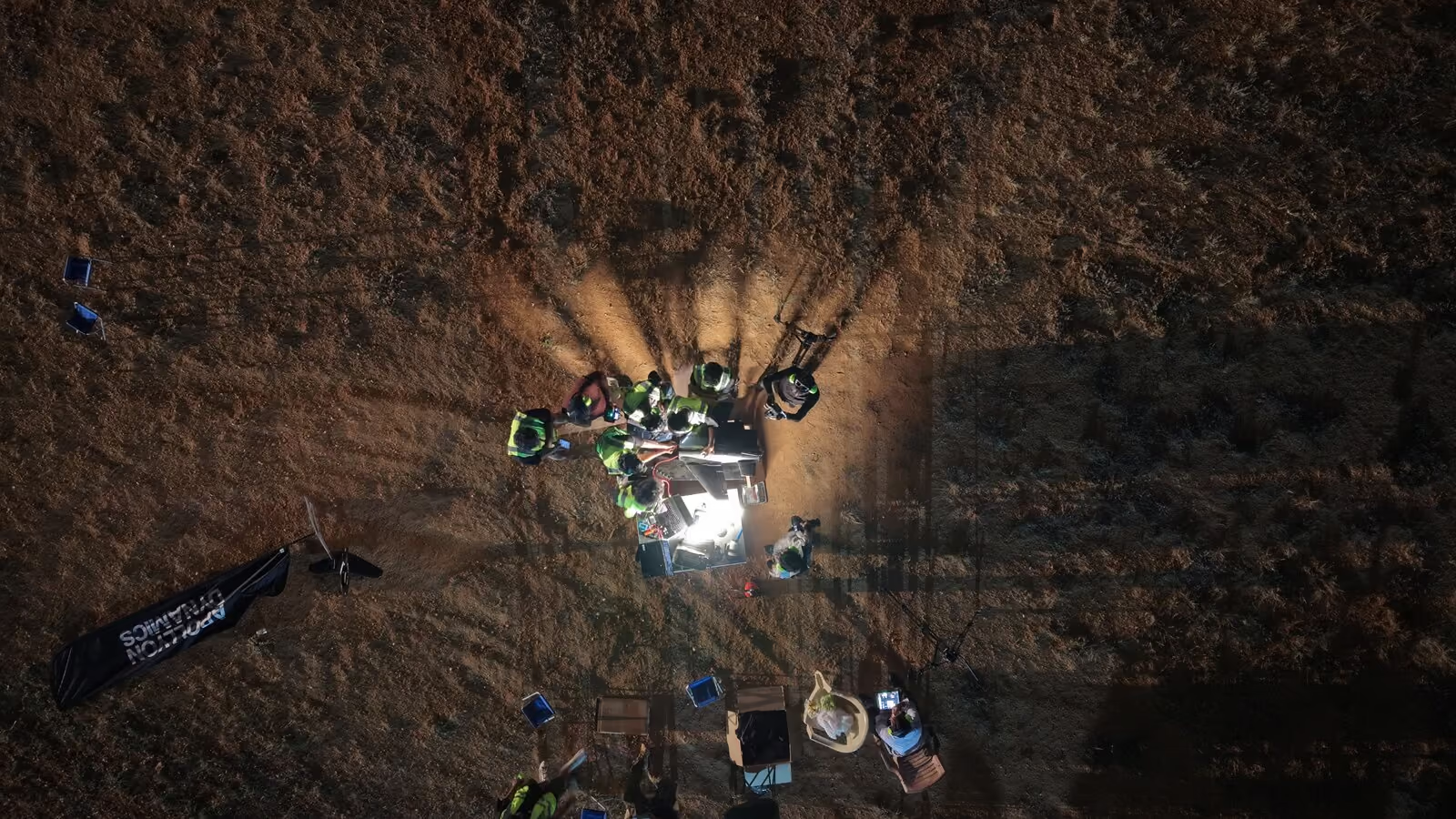
A successful demonstration answers an important question: can this machine work? Delivery introduces several more. Can the next unit be built consistently? Can it be maintained where it is used? Can a change be tested, documented and introduced without losing control of the product?
These questions shape the layer of defence manufacturing we call India’s missing middle. It brings together engineering, repeatable production and the ability to adapt. Building that combination is the work around which Apollyon Dynamics is being organised.
A different industrial rhythm
India has substantial industrial capability at both ends of the defence spectrum. Established ordnance manufacturers produce ammunition and equipment through mature processes and long production runs. Strategic programmes bring together advanced research, specialised facilities and years of qualification to deliver exceptionally complex systems.
Both serve essential purposes. Their different timescales reflect the responsibilities they carry. A strategic programme may require a long period of development because the consequences of failure, the complexity of integration and the burden of assurance demand it.
Alongside these capabilities sits a requirement for systems whose economics and development rhythm are different. They need useful technical sophistication, affordable production and a way to incorporate changing requirements throughout their lives. They also need the manufacturing and support organisation that makes repeated delivery possible.
Our Missing Middle doctrine describes this as an industrial category. The “middle” refers to the combination of cost, production and adaptation that a programme requires. It cannot be identified simply by the size of an aircraft or the price of a prototype.
Repeatability is a capability
Prototype development rewards ingenuity. A small team can work closely around a single machine, solve problems as they appear and carry a great deal of knowledge in conversation. That can be productive while a design is taking shape.
As deliveries grow, the organisation must make that knowledge usable by more people. Assembly needs clear instructions. Inspection needs acceptance criteria. Suppliers need a defined specification. Maintenance teams need to know which configuration they are supporting and how changes affect it.
This work determines whether an engineering result can become a dependable product. A component that performs well on one carefully prepared machine still needs to be produced consistently. A repair that an experienced engineer can complete in the workshop needs to become a support process others can follow.
Manufacturing therefore belongs inside the definition of capability. Production yield, delivery consistency and maintainability help determine what a customer can actually rely on. They deserve attention alongside the characteristics that fit neatly on a specification sheet.
Change needs an engineering process
Autonomous systems combine physical machinery with software. A change to one part can affect behaviour elsewhere, which makes disciplined verification essential.
The ability to revise software creates an opportunity to improve a product during its life. Realising that opportunity requires configuration control, test evidence and a clear release process. An organisation needs to know what changed, why it changed and which equipment is running the approved version.
Speed comes partly from having this structure ready. A team that can trace a field observation to a particular configuration can investigate it with more confidence. A maintained test environment gives a proposed revision somewhere to be evaluated. Documentation lets the reasoning survive beyond the engineer who first understood the problem.
These are continuing investments. Their value increases as programmes accumulate, because the company becomes better at turning observations into decisions it can substantiate.
Building on India’s industrial base
India’s existing manufacturing industries provide an important foundation. Precision machining, electronics production, composites and automotive manufacturing bring skills, supplier relationships and experience with repeatable work.
Drawing on that foundation still requires engineering effort. A supplier’s general competence must be matched to a defined requirement. Processes need to be assessed, components qualified and changes controlled. The relationship becomes valuable through that work.
For a young defence company, building supplier capability is part of building its own capability. A reliable delivery schedule depends on people and processes outside the final assembly facility. So does the ability to maintain production when a source changes or a component becomes unavailable.
This is why our industrial argument extends beyond the factory we operate. We want each programme to deepen the network of manufacturing knowledge, qualified suppliers and support arrangements available to the next one.
The state remains indispensable
Private companies can take development risk, organise engineering teams and build production capacity. They operate within a wider national system that provides capabilities no individual startup can create on its own.
The armed forces define operational needs. Public institutions provide proving infrastructure, safety oversight and specialist knowledge. Procurement demand helps determine whether an investment in production can be sustained.
The relationship works best when these responsibilities reinforce one another. Industry needs opportunities to demonstrate performance against clear requirements. Customers need evidence that a promising development can mature into reliable deliveries and long-term support.
Predictable demand matters because production investment reaches beyond the next prototype. Training people, qualifying suppliers and establishing consistent processes take time and money. A credible path from evaluation to procurement gives industry a basis for committing those resources.
Where Apollyon stands
Our programmes are at different stages of that process. As of October 2026, Ahuti is in pre-production flight testing. Nightshade has a flown demonstrator, with target-drone prototypes and the later Mk II configuration on separate development schedules. Piranha is in build, while Hemlock remains a concept.
Those distinctions matter. A portfolio describes both work completed and work still to be earned. An ambitious roadmap gains substance through demonstrated progress, and each programme needs its own evidence of readiness. Our company timeline records that progression.
The longer-term aim is to build an engineering institution capable of taking on progressively harder programmes. We use “neo-prime” to describe that ambition: a company that accepts responsibility for complete systems while accumulating the research, manufacturing and support capabilities needed to deliver them.
A standard we can be measured against
In The New Arsenal, we identify the measures through which that ambition should be judged: validated performance, reliability, production yield, qualification, field acceptance and test maturity.
These measures connect engineering promises to industrial evidence. They ask whether a result can be reproduced, whether a customer can depend on it and whether the organisation is becoming more capable with experience.
India’s missing middle will be built through that accumulation. Every delivery should strengthen the people, processes and supplier relationships behind the next one. Our task is to make that progress visible in the systems we build and the responsibility we take for them.