What Makes a Defence System Sovereign?
Design ownership, support arrangements and qualified alternatives determine how a defence system can be maintained and improved throughout its life.
Apollyon Dynamics · 18 October 2026 · 5 min read
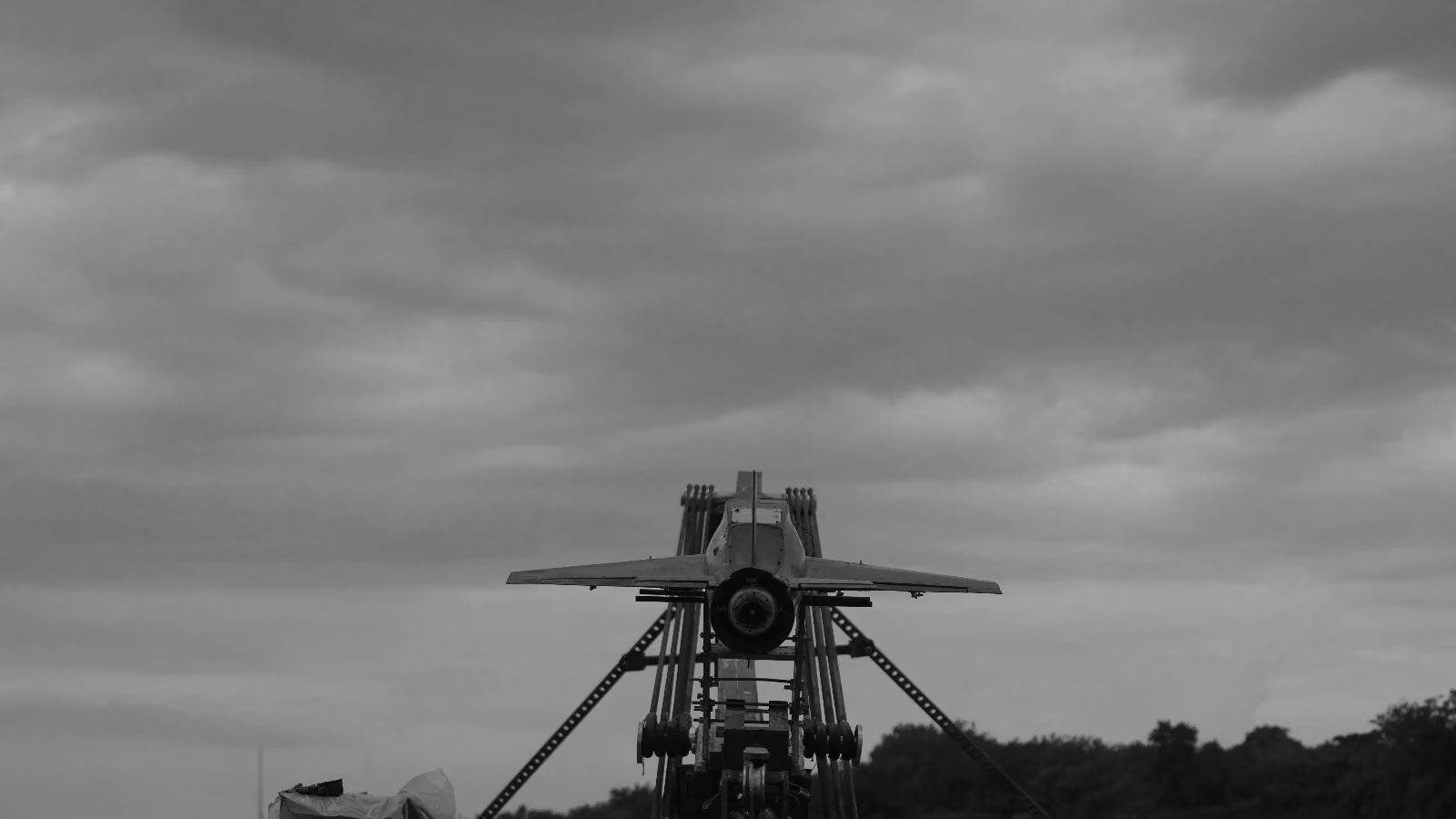
A defence system arrives with a history of decisions. Its components come from particular suppliers. Its software carries particular rights and restrictions. Its maintenance depends on documentation, equipment and people who understand how it works.
Those decisions continue to matter long after delivery. They influence who can repair the system, who can change it and what happens when a supplier can no longer provide support. For Apollyon Dynamics, the practical work of sovereignty begins with understanding those obligations and taking responsibility for them.
Looking beyond the assembly line
Domestic manufacture builds valuable capability. It creates employment, develops production skills and gives the country a stronger industrial foundation. Domestic content is one way to measure that progress.
Understanding a complete system also requires a view of its dependencies. Where does the design authority sit? Which software can the manufacturer change? Who can diagnose a failure? What evidence would be needed to introduce an alternative component?
The answers can differ within the same product. A company may own the structure and its manufacturing process while licensing an electronic subsystem. It may integrate technology from a domestic partner while buying standard hardware internationally.
An honest account of sovereignty makes these arrangements explicit. It gives customers a clearer picture of the capability being built and the work that remains.
Different layers need different forms of responsibility
Our supply-chain approach groups the system into several forms of ownership and supply.
Some layers are designed and maintained in-house. These include our vehicle architecture, composite structures and authored configuration packages. Responsibility includes retaining the design knowledge and the records needed to reproduce and revise the work.
Other capabilities come through domestic industrial partnerships. These allow a system manufacturer to draw on specialist knowledge while strengthening the wider Indian industrial base. The partner remains an engineering institution with its own expertise and intellectual property.
Externally sourced components require continuity planning. Multiple qualified sources can reduce dependence on one supplier, while standard hardware can offer broader availability. In both cases, the availability of a component is only part of the question. Its suitability for the system must also be established.
The organising principle is accountability. Every important layer needs a clear owner, a support arrangement and an understood path through foreseeable changes.
A concrete example: the flight-control baseline
The distinction between ownership and integration is visible in our Nightshade flight software.
Nightshade uses Embention’s Veronte Autopilot 1x as its initial commercial flight-control baseline. Apollyon develops the configuration packages and authored control, mission and safety logic within the vendor’s toolchain. The underlying vendor firmware and hardware remain distinct from the work we own.
This gives us a defined foundation on which to develop the vehicle. It also creates a vendor relationship that must be managed over the product’s life. Lifecycle documentation, configuration governance and support continuity are part of that relationship.
Our flight-software documentation describes this boundary directly. It matters because a broad statement such as “we build our own software” can conceal several different arrangements. Readers should be able to understand which layer the statement refers to.
Architectural ownership means knowing those boundaries and accepting responsibility for the complete system assembled around them.
Independence develops in stages
Our stated roadmap is to develop an in-house flight-control baseline once production is steady, then qualify it before transitioning platforms. That is a future development programme, with its own burden of testing and assurance.
The sequence reflects a practical constraint: an organisation has to decide where to concentrate its engineering effort at each stage. Developing every subsystem simultaneously introduces demands on people, capital and verification capacity. Using an established external baseline allows some of that capacity to be directed toward integration and product development.
The dependency remains visible throughout. Replacing it requires more than completing a new design. The organisation must establish that the replacement can be supported and that its behaviour meets the requirements of the platform using it.
A roadmap records an intention. Completed qualification establishes a different level of confidence. Keeping those stages distinct makes progress easier to assess.
Partnerships build national depth
A sovereign industrial base consists of many capable organisations. Specialist suppliers develop knowledge that a system manufacturer can draw upon, while system programmes give those suppliers demanding requirements and opportunities to mature their work.
Our relationship with Tonbo Imaging is part of this model. It brings domestic specialist capability into our development programmes. That contribution has value in its own right, alongside the work performed inside Apollyon.
Building the complete system also requires managing the interfaces between organisations: specifications, changes, testing and the responsibilities each party accepts. A strong partnership makes those boundaries clearer and makes collaboration more dependable.
Over time, these relationships can leave India with greater engineering depth. More of the knowledge needed to develop, manufacture and support complex equipment resides within a connected domestic industry.
An alternative must be ready to use
Supply resilience is sometimes described as having more than one vendor. The engineering question is whether an alternative is qualified for the role it would take over.
A component may be commercially available and still require substantial assessment before it can enter a controlled product. Its documentation, consistency and support arrangements matter alongside its nominal specification. Changes need to be evaluated against the requirements of the complete system.
Our published supply-chain review includes open qualification and sourcing work. These entries describe continuing responsibilities. They also give us a way to distinguish an identified alternative from a completed transition.
This work is less visible than a new product announcement, but it contributes directly to the ability to keep supporting customers.
Sovereignty needs evidence over time
The useful questions are concrete. Who holds the design records? Which software layers can be maintained independently? What support remains available if an original supplier withdraws? Which alternatives have completed qualification? Which transitions are still planned?
The answers will change as programmes mature. A company can own more of its technology, deepen domestic partnerships and qualify additional sources. It can also discover new dependencies as its products become more complex.
For Apollyon, sovereignty is an engineering and industrial responsibility that continues throughout that development. We want the progress to be inspectable: in what we own, the partnerships we build, the equipment we can support and the transitions we have completed. That is how a commitment to strategic autonomy becomes an enduring capability.